
What exactly is a microbe?
Bacteria, amoebas, viruses, fungi... what's the difference?

I read articles nearly every day about microbes. While many are jargon-laden academic pieces, many more are news articles and pop-science pieces like the one you’re reading now. A lot of them tend to use “microbe” (myself included) as a blanket term for anything that lives in the microscopic world without any detailed description. Its use assumes that the reader knows the difference between a bacterium and a virus, or how a protist is different from a fungus. More often than not, however, these critical differences aren’t common knowledge and our health suffers for it. I have a PhD in Microbiology with over a decade of experience, and even I had to pause and do a quick Google when I read about the explosive diarrhea rampaging through the US to remind myself where these poop-inducing metazoans sit on the Tree of Life.
So I thought that today, we could all do a refresher course together. We’ll untangle our cilia from our hyphae, and put to bed the reason that most antibiotics won’t cure that nasty cold you have.
So, what is a microbe?
A microbe is any organism that cannot be seen by the naked eye. Some cause disease, some do you a great deal of good, but the vast majority are carrying on with their minuscule lives with no effect on you whatsoever. Broadly speaking, they are split into three major groups:
Eukaryotes
Prokaryotes
Viruses
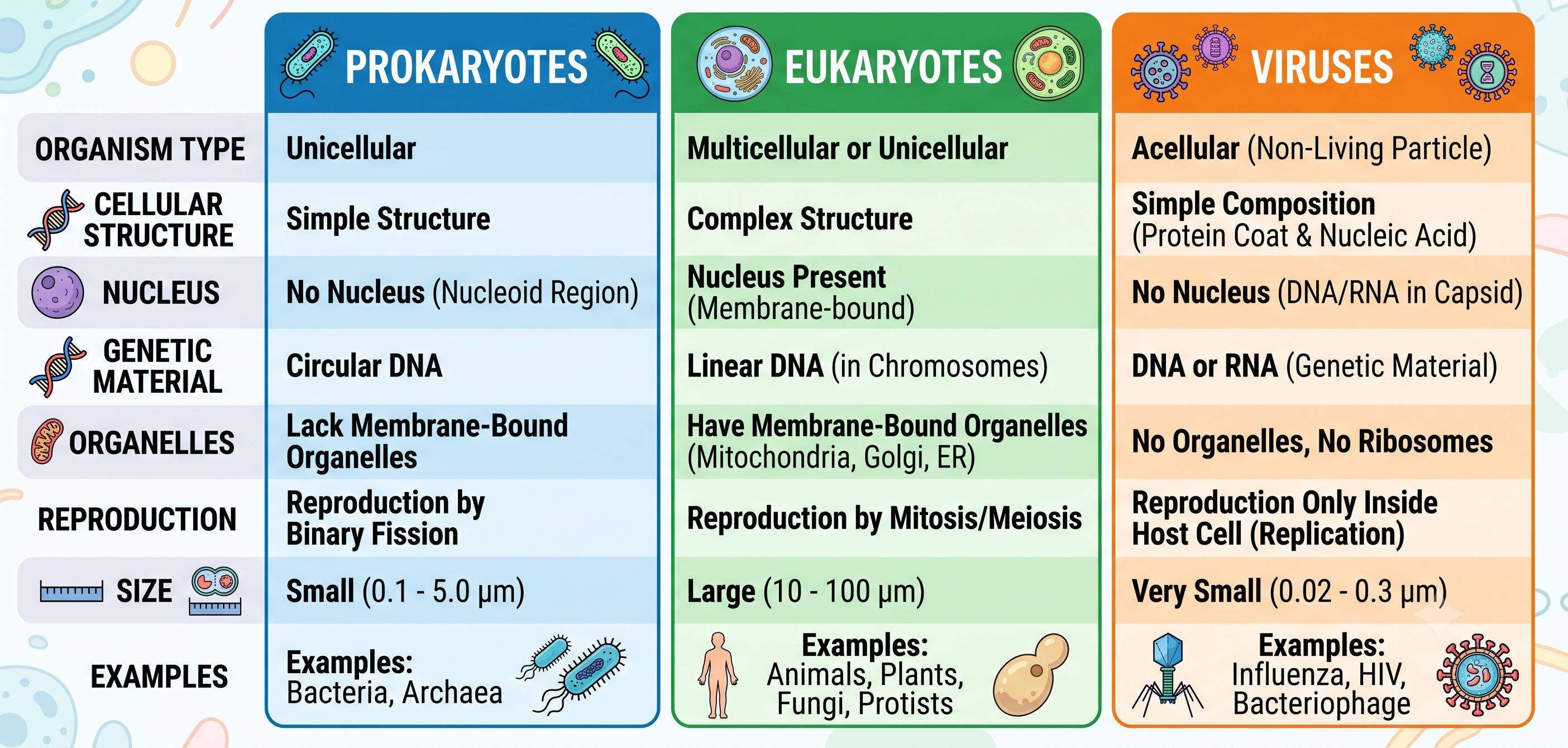
In a nutshell, eukaryotes (like fungi and amoebae) are larger and have membrane-bound nuclei. Prokaryotes are smaller and include bacteria and their more mysterious relative, archaea. Viruses are the smallest of them all (they can even infect bacteria!) and, technically speaking, they’re not really “living”. Let’s start with the smallest ones…
Viruses
Viruses are tiny. Very, very tiny. You could fit roughly 1000 of them across the width of an average human hair. You can pack about 100,000 of them in a human cell - a little over the seating capacity of Wembley Stadium (UK) or Lambeau Field (US)! Their one goal in life is to replicate. They don’t have the machinery to do that, so most of the time, when they invade a cell, they hijack the host enzymes and use them to replicate themselves. A good virus, in evolutionary terms, doesn’t want to kill you. It wants to use you to replicate and then keep you alive to spread it to the next person. The really scary ones, like Ebola, are actually terrible viruses. They kill off the infected person too fast to really spread. The flu, on the other hand, is a masterful virus – skillfully using you to replicate itself, and then catching the sneezing-coughing-super highway to the next unfortunate soul.
Structurally, viruses are basically balls of proteins encapsulating nucleic material (DNA or RNA), in varying forms of complexity. Some are simple balls (spherical), others look like DnD dice (polyhedral), some are more reminiscent of springs (helical), and some look like they're engineered to go to the moon (complex).
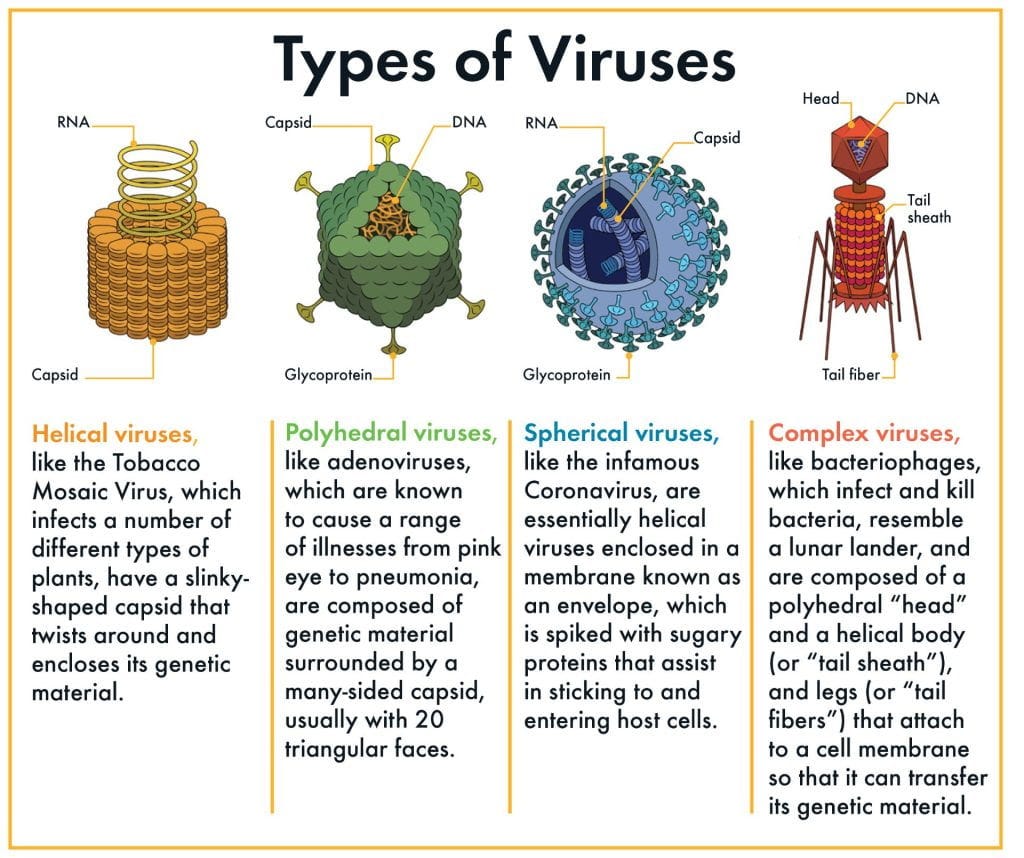
There are a little over 16,000 virus species that humans have cataloged (with countless more to discover), but only 270 or so infect humans. The vast majority of the remaining viruses are bacteriophages, which are viruses that infect bacteria. In fact, this ability to infect bacteria has given rise to a new avenue of research into “phage therapy” – using bacteriophages to combat bacterial infection in humans when antibiotics don’t work.
And that leads us to an important distinction: antibiotics cannot kill viruses. Only very special compounds, referred to as “antivirals,” are capable of incapacitating viruses. Most antivirals target the enzymes that viruses use to replicate their genomes or help build their protein shell. And, honestly, robust antivirals are tricky to make because of how rapidly viruses can evolve.
Antibiotics, on the other hand, tend to target the cell walls of prokaryotes and the enzymatic machinery they use to make their enzymes and DNA. In short, prokaryotes have very different structure and physiology.
Prokaryotes
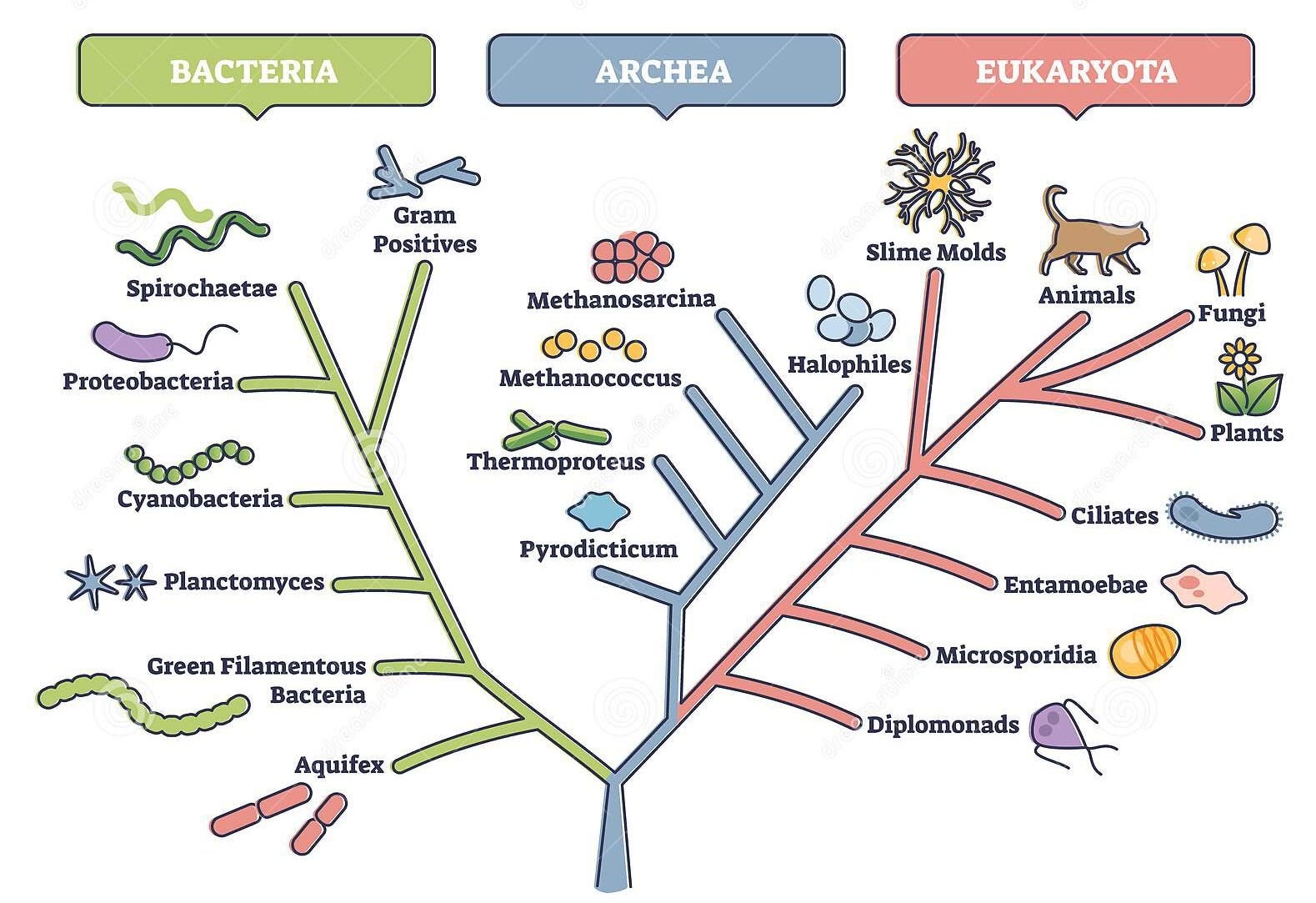
Prokaryotes are made up of only two types of organisms: Bacteria and Archaea. Both descend from the Last Universal Common Ancestor, or “LUCA” to his friends, who is the enigmatic theoretical organism that gave rise to all life on Earth.
Side note: If you want to learn more about earliest life, give one of my earlier posts on stromatolites a read!

But basically, bacteria and archaea are like siblings. Much like human siblings, archaea and bacteria are fairly similar: both are single-celled microorganisms with relatively simple, circular genomes that float freely within the cell, unbound by a membrane. Well, really, pretty much all of the internal machinery within the cell, their organelles, aren’t membrane-bound. There are, of course, exceptions to this rule, but by and large, their enzymes are unconstrained and unattached within their jelly-like cytoplasm.
However, beyond these fundamental similarities, bacteria and archaea have evolved to be strikingly different. To survive the abrasive world around them, early bacteria and archaea began exploring and evolving different architectural routes to build up their cellular fortresses. Bacteria would opt to develop a cell wall composed of peptidoglycan, a flexible mesh of proteins and sugars that acts like modern-day Kevlar that can be altered and mended on the fly. In addition to this protective wall, they added another line of defense: their membrane. This membrane is normally situated behind the cell wall and serves as a protective cushion against external hazards. Some bacteria have added a second membrane, outside the cell wall, like a defensive barrier around the cell. This layering of flexible and dynamic walls means the bacteria can more easily adapt to unexpected environmental changes and divide at an alarming pace. Archaea, on the other hand, have evolved to be something more akin to a nuclear bunker. They often sport a shell made almost purely of protein bedazzled with a sugar or two. This shell is supported by a concrete-like membrane behind it, held together by tough, resilient bridges, allowing them to survive in environments like boiling hydrothermal vents and acidic hot springs that would decimate their bacterial brethren.
In short, archaea are like doomsday preppers, hunkered down in tough, resilient bunkers, made of metabolically expensive proteins. They ration themselves, and as a result, they grow and divide relatively slowly. While the bacteria, aided by their metabolically cheap but elastic sugar-based walls, are more like an army of soldiers, multiplying at speed and invading new regions, surviving through sheer quantity and metabolic economy.
Eukaryotes
So, for a very long time, bacteria and archaea reigned supreme as the dominant life forms. Then, roughly two billion years ago, two seismic evolutionary leaps were about to change the course of biological history. The first was a merger of an archaeal cell and a bacterial cell. The small, unassuming bacterium that had been incorporated into the archaeal cell had developed a revolutionary, game-changing technology: the ability to use oxygen as an energy source. And as the host archaeal cell adapted and diversified, the internal bacterium would go on to evolve extensively with it. The engulfed bacterium would hand over some genes to the archaeal genome and reduce its own genome, streamlining its metabolic efficiency. Why bother doing something if your host is willing to do it for you? Just focus on what you do best, right? And that was using oxygen to make energy. That clever, engulfed bacterium is a familiar one to us: known as the powerhouse of the cell, that bacterium is now called the mitochondrion. Together, the swallowed (but not eaten) bacterium and its archaeal host formed what is termed a “proto-eukaryote”; the most ancient of ancestors to animals, plants, fungi, and, of course, you.
Eukaryotes are broken into roughly four major groups: plants, fungi, animals, and protists. The first three are recognizable because they’re mostly large and multicellular (i.e., one organism is made up of a bunch of different cells). And to be entirely transparent, “protists” is pretty much a catch-all term or group for all the unicellular (single-celled) eukaryotes, like amoebas and diatoms. What unifies them all is the fact that their nucleus, the bit where the genome is stored, and a lot of their other cellular machinery (organelles) are surrounded by a membrane.
So there you have it! Simply put, viruses are just DNA (or RNA) coated in protein and bent on world domination. Prokaryotes, like bacteria and archaea, are single-celled, fully enzymatically equipped, and have achieved world domination. Eukaryotes are more complex beings, wrapped up in cozy membranes and unwitting hosts to prokaryotes and viruses. And if you ever forget those differences, just go ahead and call them “a microbe”!
References
https://doi.org/10.1016/j.tim.2022.07.002
This was a really fantastic read! I loved the tone and clarity.
Great summary! Love the similies. Where do you fall on the are viruses alive or not debate?