

Ringworm Isn't a Worm
So, what is it?

I peered at my friend’s foot in utter fascination. There was a near-perfect circle of little raised bumps on her ankle, and my mom had said it was “ringworm”. I must have been eight at the time, and I was equal parts intrigued and repulsed by the idea of a wriggling worm making its home right beneath the surface of the skin. I prodded it with my finger, expecting it to writhe and contort like the earthworms I’d uncover when digging in the garden. But nothing, no movement. The worm that lay there was unperturbed, in its little fairy ring of red bumps. My mother quickly scolded me and warned me not to touch it again. “But why?” I remember thinking, “How could this worm possibly get out and into me just by touching it?”
The reason I could “catch” the worm is that ringworm is actually a fungus. And that fungus is a “dermatophyte”. “Derma” means skin, and “phyte” means to grow; so a dermatophyte is, literally, something that grows on skin. And to grow, it needs to eat. In this case, that means eating you. Specifically, they consume keratin, a protein found on the surface of your skin and in your hair and nails. The fungus starts at a central point and then moves outward with its hyphae (fungal filaments) in search of new food, and these hyphae trigger your immune response, resulting in the characteristic ring of scaly, red, raised skin. The center clears out as the fungus does, depleting the keratin in that area.
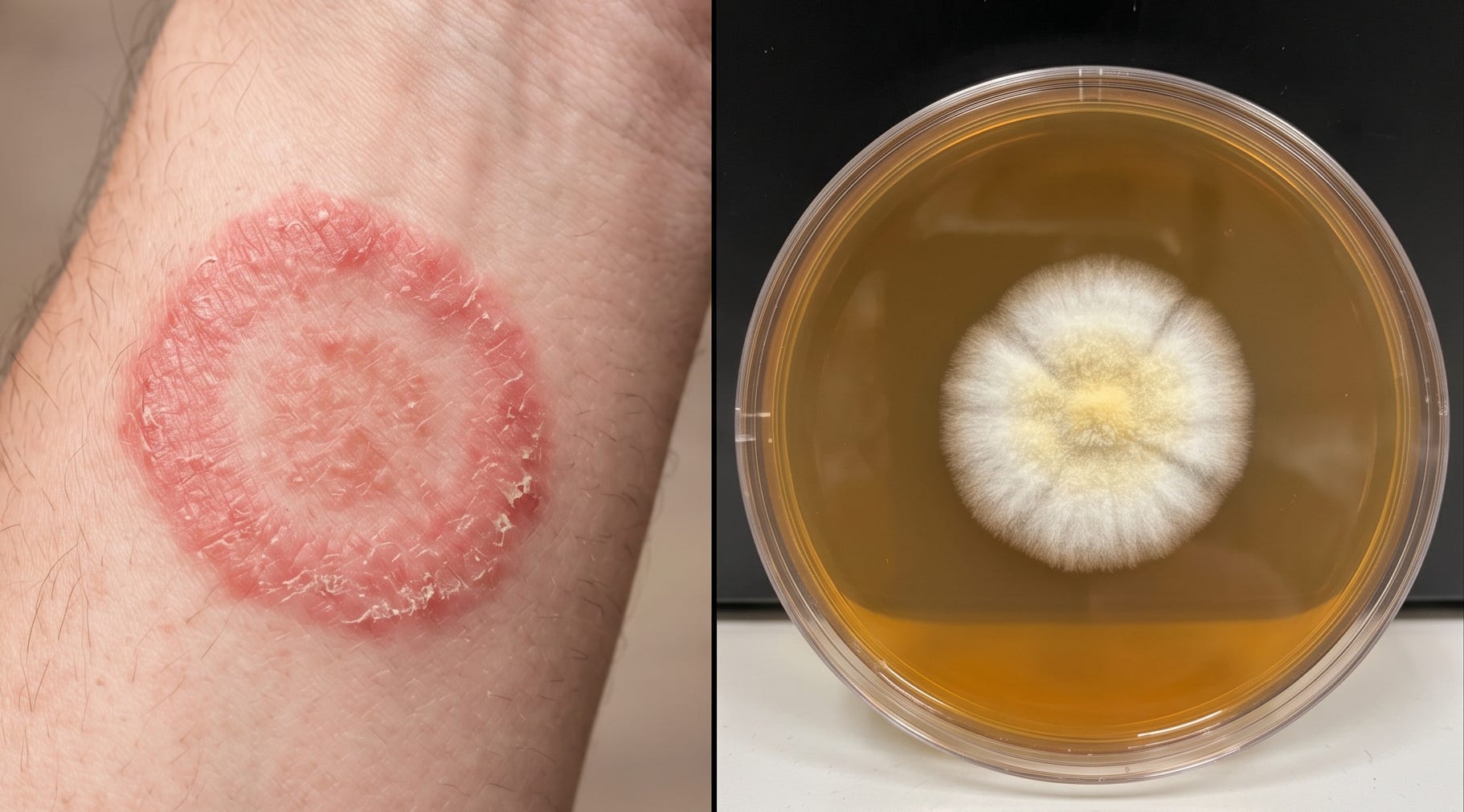
But not all ringworm fungi are the same. Some like to snack on us (anthropophilic), others prefer the taste of animals (zoophilic), and some are just content within the dirt (geophilic), chowing down on animal debris like feathers and fur. My little cat, Dirtbike, got ringworm on his nose a few years ago. He looked absolutely ridiculous as the fur around his nose seemed to just disintegrate. At first, I thought he had scraped his nose on something, but as the infection spread, I realized something was wrong and took him to the vet. The vet uses ultraviolet light to check for ringworm, as the species that infects animals fluoresces a bright, eerie apple green when exposed to blacklight. This fluorescence is caused by a chemical byproduct called pteridine, which the fungus emits as it gobbles away at the hair shafts.

When we got home, we had to deep-clean everything relentlessly. This is because when a person or animal scratches the ringworm, hundreds to thousands of spores are sent drifting into the air, landing on furniture and carpets. Those spores can lie dormant for months, so prompt clean-up is definitely necessary to contain the spread. Sadly, despite cleaning like a crazy person, I ended up catching it as well and developed a rather unsightly infection on the outside of my thigh. Thankfully, the infection is completely treatable, with most treatment regimens consisting of both oral and topical antifungals for both humans and pets alike. Within just a few weeks, both my kitty and I were fungus-free, and we’ve never suffered another infection since.
But I will admit, as I looked at that red raised ring on my leg, there were definitely moments where I thought I’d see it wriggle. I just had to remind myself that it was just a fungus. But even then, picturing thin tendrils of fungal hyphae creeping along my skin, I couldn’t help but think that “just a fungus” wasn’t any more comforting than a worm doing the same.